

How To Draw Blood Cultures From A Central Line
| Ensure that patient and health care provider safety standards are met during this procedure including:
| |
|
|
PROCEDURE | |
| Ordering Blood Cultures in CCTC: Any society for blood cultures should consist of a MINIMUM of two complete sets of cultures. Each set of cultures should be drawn from a different draw (due east.g., 2 dissimilar venipuncture sites or a venipuncture plus line site(s). RNs carry a medical directive to lodge cultures when indicated. Line details should include the type of intravascular device (e.one thousand,. triple lumen, arterial line, PICC, Hard disk catheter), the site (e.m., right IJ) and the date of insertion. Be sure to specify the blazon of central line. Line details must exist entered at the time the orders are placed. The purpose of drawing ii or more cultures is to increase the sampling yield and to help to rule out contamination. In the rare event that cultures tin can simply be obtained from a unmarried draw or site, the reason for the single depict should be documented. Do not draw ii sets of cultures from the aforementioned draw (as this would still exist a unmarried draw specimen and lead to misinterpretation of results). Nurses are accountable to ensure that cultures are fatigued as per protocol. If a physician orders a unmarried blood civilisation, the nurse is authorized to obtain a second set up. Ideally, blood cultures for patients with indwelling intravascular lines should include 1 venipuncture plus whatever indwelling line cultures. In CCTC, all blood culture orders should be entered past a nurse to facilitate the entry of details about the line insertion. This data cannot be entered in one case the social club has been placed. If a physician enters an gild for blood cultures (and this information has not been entered with the order), abolish the blood culture guild should exist cancelled and re-entered with the necessary information. This should include the date of insertion, the location of insertion (e.thousand., R IJ) and type of catheter (east.g., specify whether the central line is a PICC or dialysis line). Quick orders for blood cultures are for "nurse to order cultures" or "nurse to pan civilization". | |
| . | Indications for Blood Cultures
Notes: Many patients are admitted with sepsis equally a differential diagnosis; prompt cultures are indicated. This should Ideally occur prior to antimicrobial therapy initiation but should non delay treatment. Staph aureus in the claret is associated with endocarditis. Staph aureus and yeast tin be hard to eradicate. Line removal is mostly required (including tunneled catheters). Claret cultures are typically repeated until they go negative. The fourth dimension when the cultures are beginning negative helps to make up one's mind the duration of antimicrobial therapy. |
| two. | Identify Number of Samples to be Collected See Blood Civilization Ordering Determination Tree: i. If the patient has no intravascular lines, draw ii sets of peripheral cultures from 2 different draws (different lines or puncture sites).
two. If the patient has intravascular lines in place that are > 24-48 hours, draw cultures and request a "CAB" cess as follows:
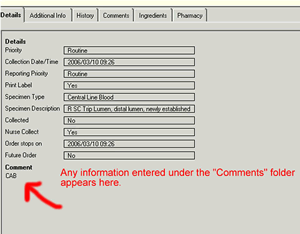
three. If the patient has a previously established line that is being removed and obtain cultures from the line and at least one other site and send the tip for culture (done semiquantitatively). NOTE: A Catheter Associated Bacteremia (CAB) assessment will only exist performed if a venipuncture sample is included (and labeled as a venipuncture sample). It required lab notification for advisable setup of cultures. If whatsoever indwelling line becomes positive more than than 2 hours earlier the venipuncture culture get-go became positive, the blood stream infection (bacteremia) is unidentified as a CATHETER ASSOCIATED BLOOD STREAM INFECTION. If all blood cultures become positive within a 2 hour window, the infection is not considered to be catheter associated. All samples must become to the lab at the aforementioned time so that they can be setup together. A newly established line can be considered a "peripheral stab" ONLY if it is newly established and has non been previously used for blood cartoon. If the sample is drawn at the fourth dimension of insertion, place this equally a "peripheral culture" in the lab orders. If a peripheral culture cannot be obtained, report this under "Comments" in Ability Chart (see item seven) and certificate in the AI menstruation sheet. (A CAB assessment will not exist performed without a sample that is labeled as "venipuncture"). Simultaneous results from multiple sites aids in the interpretation of the results (e.thousand., differentiates contagion, colonization and clinical infection). Multiple samples besides increase the yield and potential for culture growth. Bloodshed increases 8% with every 1 hr filibuster in the administration of appropriate antimicrobial therapy (ie. covers the actual organism). The initial pre antibiotic claret culture is oft the just 1 that shows the causative organism. TIP Cultures: A positive tip civilisation with > 15 CFUs of an organism is used to identify that the catheter is the likely source of the positive culture (indicates high brunt of organism attached to the catheter tip). |
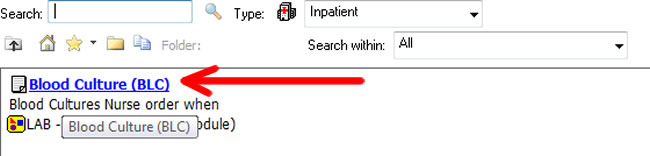
| 3. | Order Blood Cultures in Power Nautical chart
Notes: Power Chart will not let 2 identical lab tests to be ordered with the same fourth dimension. |
| | |
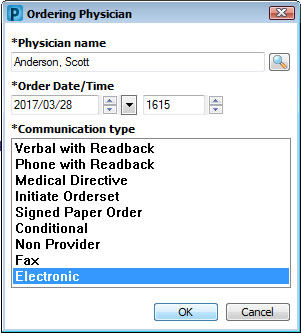
| Enter ordering physician. Choose "electronic guild" for Advice Type if you received a "nurse to gild claret culture" communication lodge. Choose "electronic society" if yous are reordering a previously entered club to provide more details Choose Medical Directive if you are initiating an order based on the Medical Directive guidelines | |
| | |
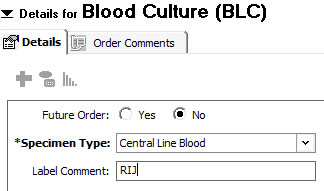
| 4. | Enter Specimen Type Under Specimen Type choose "Venipuncture", "Arterial Line Blood " or "Primal Line Blood " from the drop downwards box Choose "Central Line Blood for a claret civilisation from a PICC, introducer, dialysis catheter or tunneled CVC In the Label Annotate, type in the information that you would like to announced on your label that will help you lot to ensure that the label matches the sample Notes: Knowledge of the source of the culture is very important to the interpretation and treatment decision. |
| | |
| | |
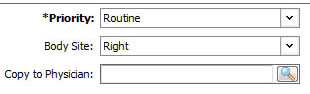
| five. | Enter Priority and Body Site: In the Priority box, get out the default entry of "Routine". Claret cultures cannot be done STAT. From the Trunk SITE drop downwards box, cull Left or Right (for speed of entry, blazon Left or Right) Notes: Interpretation of results and treatment decisions depends upon a clear agreement of the sample. Blood cultures crave a minimum period of fourth dimension for growth. Other specimens such every bit bronchoscopy sample or CSF specimen can exist done STAT (this will provide a gram stain report). |
| | |
| | |
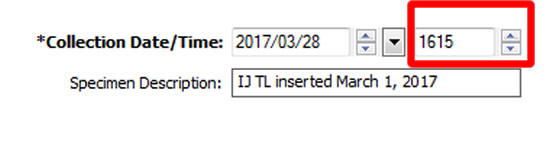
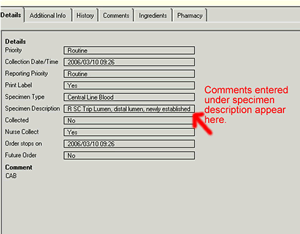
| 6. | Enter Collection Time and Specimen Description Adjust the ordering fourth dimension for each blood culture sample (due east.g., peripheral, arterial, primal) to ensure they are at least one infinitesimal apart. In the Specimen Description box, enter the following information:
If this is a newly inserted line and the first sample beingness fatigued, identify this equally "newly inserted". Samples drawn at the time of line insertion may be labelled as "venipuncture" if needed for the purpose of obtaining a CAB assessment. |
| | |
| | |
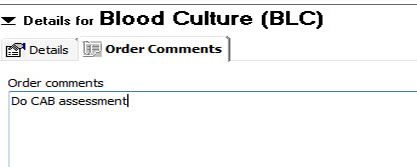
| seven. | Request Catheter Associated Bacteremia (CAB) Assessment If the patient has indwelling lines and the lines are not existence immediately removed:
If the indwelling line is being removed, send cultures and a tip civilisation, but Exercise NOT request CAB assessment. CAB (Catheter Associated Bacteremia) cess provides a "time to positivity effect". If an indwelling line becomes positive by > 2 hours before than the peripheral sample, it suggests increased colonization of the catheter. If both the peripheral and line cultures become positive within two hours, information technology suggests bacteremia. Click to view Catheter Associated Bacteremia algorithm (only bachelor from inside LHSC). CAB assessment is not needed if the catheter is being removed. A tip civilisation provides a quantitative evaluation of organisms. A colony count > fifteen plus a positive blood civilization is indicative of Catheter Associated Bacteremia. |
| | |
| 8. | Collect Specimens Perform hand hygiene and don non-sterile gloves. Alter the needleless access port prior to obtaining blood cultures Scrub the tiptop of each specimen canteen with a split swab Scrub vigorously in a horizontal management using the get-go swab. Scrub vigorously in a vertical direction with the second swab. Allow the prep to dry FOR One FULL MINUTE earlier sampling. Exercise Non DRAW A DISCARD SAMPLE UNLESS In that location IS CITRATE BLOCKING SOLUTION IN THE LINE. Collect a 10 ml sample for EACH canteen (discard volume is included in 10 ml sample). Citrate has antimicrobial properties, therefore, information technology should be removed from the sample before introducing it into the broth. Ensure that air does not enter the anaerobic canteen during collection. Remove non-sterile gloves and perform hand hygiene. Transport samples down to lab in a biohazardous pocketbook. Notes: Citrate may have clarified backdrop; a discard sample is required (due east.thousand., for hemodialysis catheters). The back and forth scrubbing loosens bacteria and provides more constructive disinfection of the site. The prep must dry out to activate the antimicrobial properties. The Eye for Affliction Control (CDC) recommends cleaning injection sites with seventy% booze or iodophors. Chlorhexidine is recommended for peel preps and has non been studied for injection sites. Utilise of a product that includes booze is recommended. |
| nine. | Label Specimens Place labels on specimens. Select i of the modest square barcodes and place on each bottle. Verify that the label proper noun and patient are correct. Verify that the label matches the right sample (e.one thousand., arterial samples and arterial labels). Sign sample requisition and tape time sample was drawn. Notes: Samples will be discarded by lab if unsigned. |
| x. | Document Medical orders are required for blood sampling. Many routine lab tests tin be ordered by a Critical Care Nurse by authority of Medical Directive. The reason for ordering a test or intervention by medical directive must exist documented. |
| 11. | View Ordering Information Select the desired blood culture lodge from the from the Power Chart Flowsheet, Orders Listing or Task List. Right click and select "Orders Data" All of the information entered when the exam was ordered is revealed. The proper name of the nurse who ordered the test is also displayed. Notes: Ordering information is available to aid in the interpretation of results. |
| | |
| Ever log off, by exiting the patient'south chart. | |



References: http://www.cdc.gov/ncidod/hip http://world wide web.cdc.gov/mmwr/preview/mmw.htm/rr5110a1.htm
Blot, F., et al. (1999). Differential fourth dimension to positivity between paired hub and peripheral claret civilisation (DTP) method. Lancet, 354: pp. 1071-1076.
LHSC Policy for claret cultures
Surviving Sepsis Guidelines 2016. Social club of Disquisitional Care Medicine.
Developed by: Brenda Morgan, CNS, CCTC
Revised: January sixteen, 2018; Reviewed: January 21, 2021, Reviewed Jan 19, 2021

Source: https://www.lhsc.on.ca/critical-care-trauma-centre/procedure-drawing-blood-cultures
Posted by: hubbardwhatefteld.blogspot.com
0 Response to "How To Draw Blood Cultures From A Central Line"
Post a Comment