

How To Draw Someone Slouched Over
How To Describe On The Correct Side Of Your Encephalon
Why y'all think you tin't draw and what to practice about it
"I cannot tell you how happy I am that I take taken upward drawing once more. I had been thinking about it for a long time, but e'er considered it impossible and beyond my abilities"
The to a higher place quote is taken from a letter written by Vincent van Gogh to his younger brother Theo in 1880.¹ 1880 marked the twelvemonth when van Gogh started his (short) painting career — he was 27 years old at the time.
I picked this quote because it really sums up what this article is about: any your age or background or what your Arts Teachers told you, learning to draw is independent of talent and everyone can learn it.
Non everyone can get the adjacent van Gogh of course. But the proficient news is that no matter your electric current skill level, with some do you'll be able to improve your drawing skills substantially. In this article I want to give you one piece of advice if you want to go better at drawing: learn how to draw negative spaces.
This article is inspired past the book Drawing on the right side of the brain past Betty Edwards², which I highly recommend reading. Information technology contains a lot more theory and practical tips, which greatly improved my drawing ability after I read it some years ago.
We all know how to draw
Drawing doesn't come naturally to all of us. However, equally kids most of us learned the basics: selection upwards a pen, put it down on a piece of newspaper and move it effectually.
Equally kids we progressed quickly. Soon we got the handle on how to describe different shapes and make use of different colours. Our parents loved information technology, encouraged us to proceed. Possibly they fifty-fifty taught usa how to depict a face like this: 1 big circular circumvolve, ii pocket-sized circles for the eyes, 1 line for the nose, and 1 more for the mouth.
At a immature historic period, nosotros learned to build abstractions of what nosotros saw in the real world. For example nosotros can group together things like fingers, lord's day rays and tree trunks because they tin all be represented by the abstract concept of a line. Similarly, optics, torsos, faces are expressions of the abstract concept of a circumvolve.
Being able to grade abstractions is incredibly useful. Rather than thinking about what things hateful or what they look similar exactly, we can apply fast brusk cuts: if you run across that there is a big carmine object on iv wheels quickly approaching, you might want to think "motorcar!" instead of continuing on the street appreciating the interplay of light & shadow on the bonnet. In less dramatic terms, forming abstractions is corking because information technology's linked to complication reduction, conceptual thinking and trouble solving³.
It'southward as well useful when you're trying to draw someone'southward confront from retentiveness. Draw Dad? Circumvolve, circumvolve, circle, line, line. Mum? Circle, circle, circle, line, line. Unfortunately, for almost of us, this is where it stopped.
At some point we stopped progressing
Skills other than cartoon became more important. We entered schoolhouse and had a whole range of subjects to report. Most of them required u.s.a. to remember analytically. For instance, we learned that symbols like words and numbers tin can stand for something else. This immune us to read, write, summarise and analyse text and to carry out calculations.
"Albert Einstein chosen the intuitive or metaphoric mind a sacred gift. He added that the rational listen was a faithful servant. It is paradoxical that in the context of modern life nosotros have begun to worship the servant and defile the divine."⁴
Every bit we grew up, nosotros tended to be getting rewarded for preparation our analytical skills like:
- The ability to limited verbally lines of thought in a clear and curtailed manner.
- Knowing the facts, to reason on them and draw logical conclusions.
- Abstract information, using symbols equally variables for something else, following procedures, carrying out operations and proving theorems.
Why y'all call up you can't describe
In an analogy to the 2 hemispheres of the human brain, Betty Edwards distinguishes between performing a task in L-fashion or in R-mode. For example, for 98% of right handers (and 2 thirds of left handers) language and language related capabilities are located in the left hemispheres. This is supported by for case the split encephalon experiments⁵ carried out by Roger Sperry.
Irrespective of where in the encephalon certain activities are carried out, Edwards considers the ones I mentioned in a higher place (the rational, analytical, procedural) L-mode activities.
What then are R-mode activities?
- Perceiving the non-verbal, visual, how things really are in the current moment in their current context.
- The non-rational & imaginative, the willingness to go against reason or facts.
- Seeing all things at once, their location, how they are related to each other, holistically and in all their complexity.
As you tin can imagine, drawing is largely an R-mode activity.
The problem when trying to draw a perception is that the fast, left side of your brain jumps in by default if it thinks information technology's suited for the task. As mentioned before, this is incredibly useful in many situations, but not if your task is to draw what is in forepart of you.
For example, if you lot're trying to draw a portrait, what you lot actually want to do is draw exactly what you meet — an R-fashion skill. But what'south most probable going to happen is that your left hemisphere takes over and gives your hands the wrong instructions: when yous look at the olfactory organ, your left brain will say "Hey, I recognise this, it's a nose. Paw: draw this abstract form of a olfactory organ — it'due south easier!".
The result is that what yous draw doesn't really resemble reality. It's more like a piecemeal of abstract concepts that your left brain conveniently compiled for y'all. Your drawings probably wait a lot similar those of a 12-yr old. Simply that's non considering of a lack of talent — it's simply because you lot haven't trained your drawing skills since you were 12.
Trick your brain
The primal to improving the quality of your drawings is not to work on your actual drawing skills themselves (although improving your technique is of course ever helpful). The lowest hanging fruit is to change the way you lot perceive what y'all want to draw — to perform a mental shift from L-mode to R-mode.
Unless the left side of your brain really dislikes the task it will happily practice it. So let's change the job slightly such that your left encephalon one-half finds it as well cumbersome and will therefore turn it downward. This volition requite your right encephalon the chance to take over!
One manner to achieve this is to merely rotate the object that you're trying to draw by 180 degrees (assuming you're not working with a life model, or your model is expert at handstands).
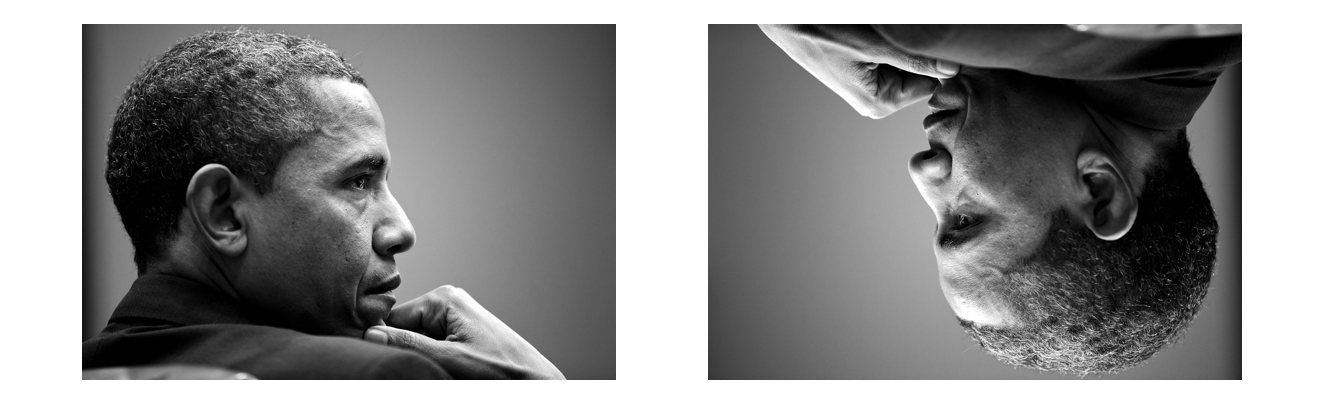
Accept for example a photograph of Barack Obama, arguably a well known person. About people would be able to straight away recognise him on the left (upright) photograph. Nigh people would probably also recognise him on the right (upside down) version, but it would accept them e'er and then slightly longer. Turning objects upside downward makes them confusing. Everything looks a bit strange and it takes some mental endeavor to rotate the image back to the original.
If you're not convinced, take a more complicated case, a drawing by Giovanni Battista Tiepolo. I rotated information technology, which makes it actually hard for me to tell what'south going on. Can you recognise annihilation without turning your screen?
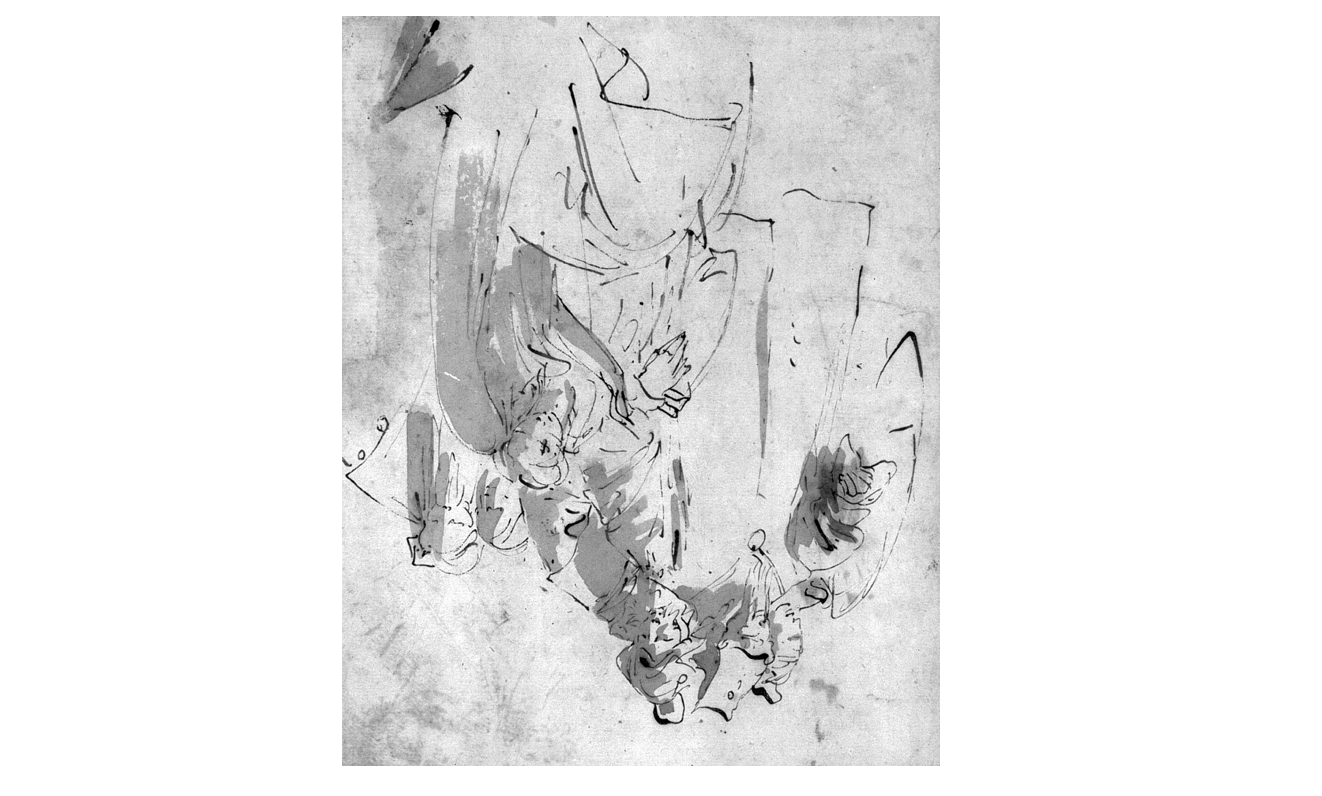
When turning an object upside down, your left brain half can't quickly attach a characterization to it. The more confused it is, the more likely that it will refuse to perform the task and permit your right brain half do information technology. That's great, because your correct hemisphere is improve at perceiving things every bit they really are. So chances are that your hands will receive the correct instructions: to draw what you actually see. Y'all performed the shift from 50-style to R-mode.
I encourage you to effort this out. Look for a blackness and white photograph or drawing, plow it upside downwardly and merely try to draw it. The more complicated the photo/painting/drawing the amend, because when turned upside downwardly, it will then be even more than hard for your left encephalon to tell what it is you're drawing, and so there'll exist less interference.
For comparing you lot might also desire to describe the same affair upright. You'll be surprised past how much better (more like the original) the upside downward one looks when you're done.
Learn how to depict negative spaces
If you did requite information technology a go, I am curious to hear what you think about the result. When I first did this exercise while reading Betty Edwards' book I was actually amazed at how big an upshot tricking your brain like this can take on the quality of your drawings.
Flipping the object you desire to depict upside down is an amazing trick, and I ofttimes apply it when drawing. In fact I sometimes rotate it less than 180 degrees ("sideways") just to look at it from a different angle and compare the shapes and proportions of what I'm drawing.
Yet, this trick is not always possible, for case when you're life drawing. In situations like that it would be great if yous could "mute" your left encephalon hemisphere and get the benefit of letting the right side of your brain accept over.
Luckily, there is a technique yous tin can acquire to sufficiently confuse your left brain one-half sufficiently while cartoon something in an upright position: to draw negative spaces.
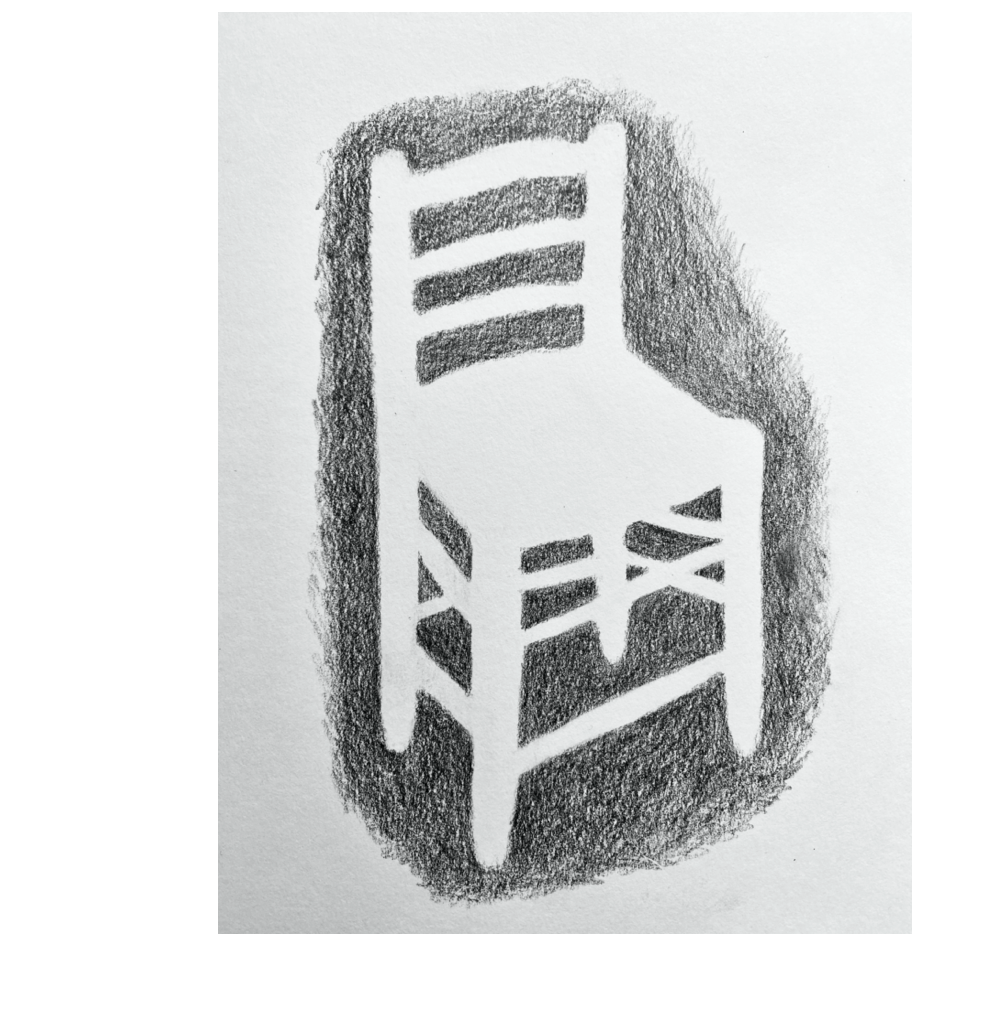
The basic idea is simple: at that place are negative spaces and positive forms. If yous're trying to describe a portrait, positive forms would be things like eyes, the nose, lips and eyebrows. And negative spaces are the areas in between those positive forms. Then they are really ii sides of the same money — if you draw positive forms, you automatically draw the negative spaces at the same time and vice versa.
Run into for example my sketch on the left. By drawing the negative spaces around the chair, I likewise drew the chair itself.
How does drawing negative spaces assist you create amend drawings? For the aforementioned reason that drawing something upside down helps you to create ameliorate drawings. The space in between someone's eyes and their nose doesn't look like anything your left encephalon half has a characterization for. So your left brain can't really deal with this chore which enables you lot to shift into R-way and have a skilful shot at cartoon it the style it is.
Concluding remarks
To sum up, cartoon is a skill that tin exist learned like whatsoever other. There is a simple caption for why near people struggle to create realistic drawings: we stopped practising the skill of drawing, or rather the skill of perceiving things, when nosotros were kids.
To see what impact perceiving things differently tin can have, attempt drawing something upside down — y'all volition be surprised by the results! The trick is to confuse the left side of your brain by giving information technology a task information technology tin can't handle: to draw something it cannot easily recognise. A more workable solution than drawing upside downwardly is learning to draw negative spaces.
Drawing negative spaces is but one of the key skills Betty Edwards mentions in her volume, but to me it was the most middle-opening and of import 1. If you want to have information technology further, take a look at the full book.
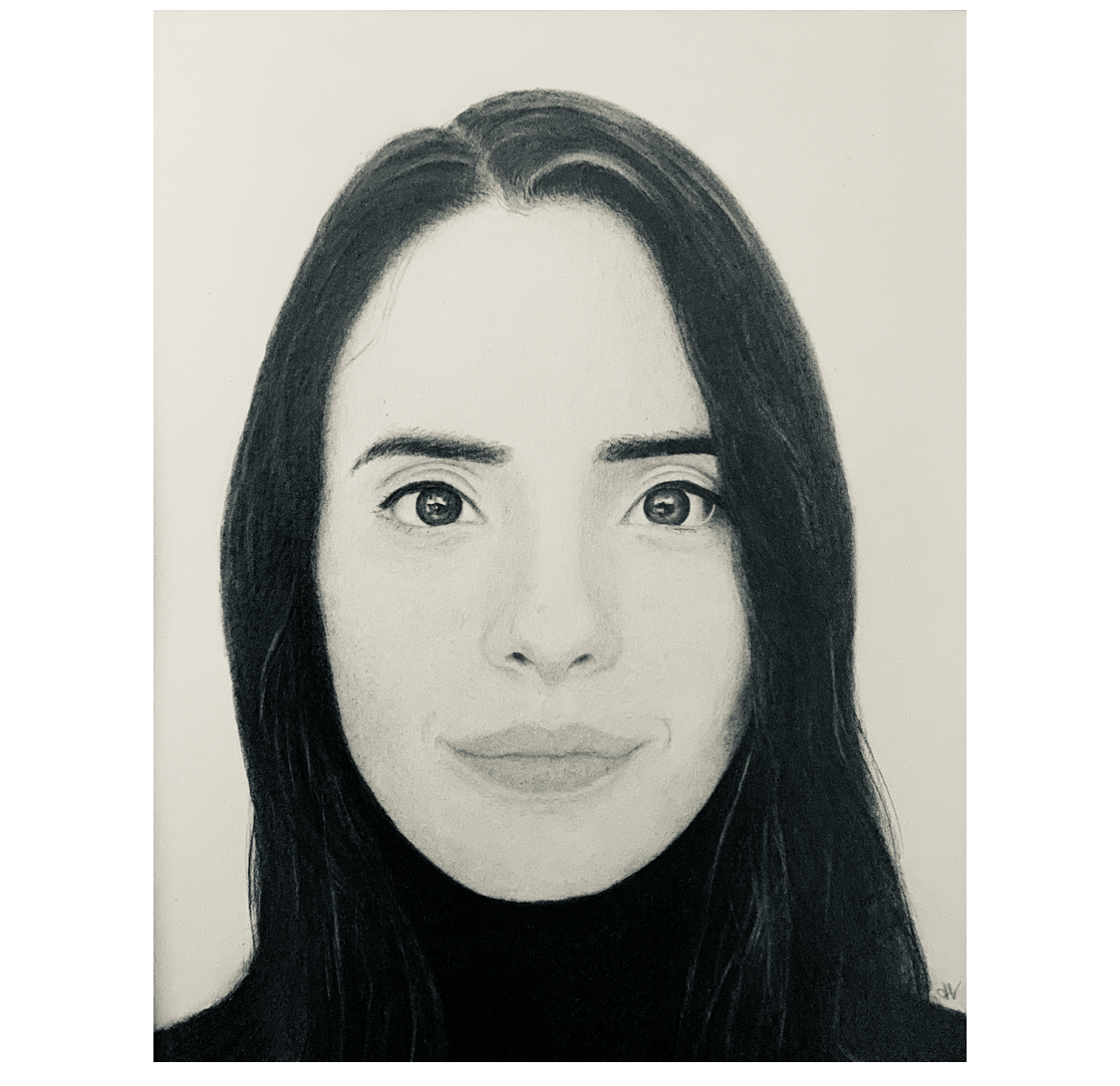
Learning how to draw is a long process and I too am somewhere in that process. Sometimes I draw upside down, sometimes not, sometimes I draw negative spaces and sometimes I draw the bodily positive forms. Sometimes my drawings plough out overnice, and other times not so much. I desire to conclude with a drawing which turned out overnice, and which was a birthday nowadays for a friend of mine.
Happy drawing everyone!

Source: https://medium.com/swlh/how-to-draw-on-the-right-side-of-your-brain-cfe620995dc4
Posted by: hubbardwhatefteld.blogspot.com
0 Response to "How To Draw Someone Slouched Over"
Post a Comment