

What Happens Chromosomes During Metaphase? And Draw It
Affiliate 6: Introduction to Reproduction at the Cellular Level
vi.two The Jail cell Wheel
Learning Objectives
By the stop of this section, you will be able to:
- Describe the 3 stages of interphase
- Discuss the behavior of chromosomes during mitosis and how the cytoplasmic content divides during cytokinesis
- Define the quiescent Thousand0 phase
- Explicate how the iii internal command checkpoints occur at the end of Chiliad1, at the G2–Yard transition, and during metaphase
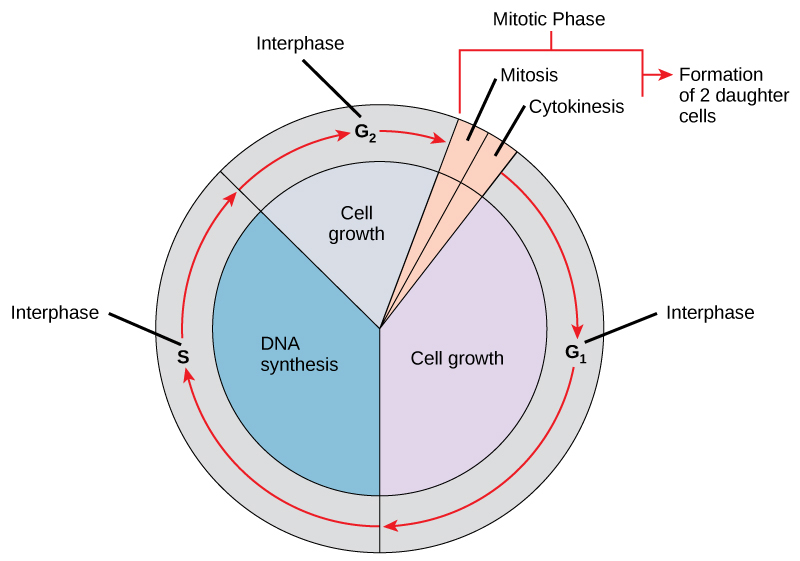
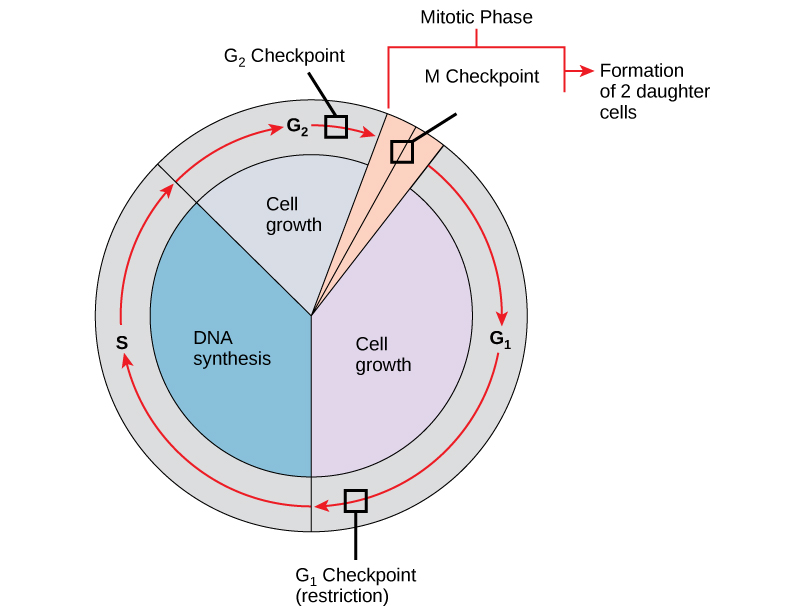
The cell bicycle is an ordered serial of events involving cell growth and prison cell sectionalization that produces ii new daughter cells. Cells on the path to prison cell division proceed through a series of precisely timed and carefully regulated stages of growth, DNA replication, and segmentation that produce two genetically identical cells. The cell cycle has two major phases: interphase and the mitotic phase (Figure 6.3). During interphase, the cell grows and Dna is replicated. During the mitotic phase, the replicated DNA and cytoplasmic contents are separated and the cell divides.
Sentry this video about the cell cycle: https://world wide web.youtube.com/watch?v=Wy3N5NCZBHQ
Interphase
During interphase, the cell undergoes normal processes while also preparing for cell division. For a cell to motility from interphase to the mitotic phase, many internal and external weather condition must exist met. The iii stages of interphase are called G1, S, and G2.
Gi Phase
The first stage of interphase is called the Kane phase, or first gap, because trivial change is visible. However, during the Thousandane stage, the cell is quite active at the biochemical level. The prison cell is accumulating the building blocks of chromosomal DNA and the associated proteins, besides as accumulating enough energy reserves to complete the task of replicating each chromosome in the nucleus.
Southward Phase
Throughout interphase, nuclear DNA remains in a semi-condensed chromatin configuration. In the S phase (synthesis phase), Deoxyribonucleic acid replication results in the formation of two identical copies of each chromosome—sister chromatids—that are firmly attached at the centromere region. At this stage, each chromosome is fabricated of two sis chromatids and is a duplicated chromosome. The centrosome is duplicated during the S phase. The two centrosomes will give rise to the mitotic spindle, the apparatus that orchestrates the movement of chromosomes during mitosis. The centrosome consists of a pair of rod-like centrioles at right angles to each other. Centrioles assist organize cell division. Centrioles are non present in the centrosomes of many eukaryotic species, such as plants and most fungi.
G2 Stage
In the Grandii phase, or second gap, the cell replenishes its energy stores and synthesizes the proteins necessary for chromosome manipulation. Some prison cell organelles are duplicated, and the cytoskeleton is dismantled to provide resources for the mitotic spindle. There may be additional cell growth during K2. The last preparations for the mitotic phase must be completed before the jail cell is able to enter the offset phase of mitosis.
The Mitotic Phase
To make two girl cells, the contents of the nucleus and the cytoplasm must be divided. The mitotic phase is a multistep procedure during which the duplicated chromosomes are aligned, separated, and moved to contrary poles of the prison cell, and and then the cell is divided into ii new identical girl cells. The starting time portion of the mitotic stage, mitosis, is composed of five stages, which accomplish nuclear division. The second portion of the mitotic phase, chosen cytokinesis, is the physical separation of the cytoplasmic components into ii daughter cells.
Mitosis
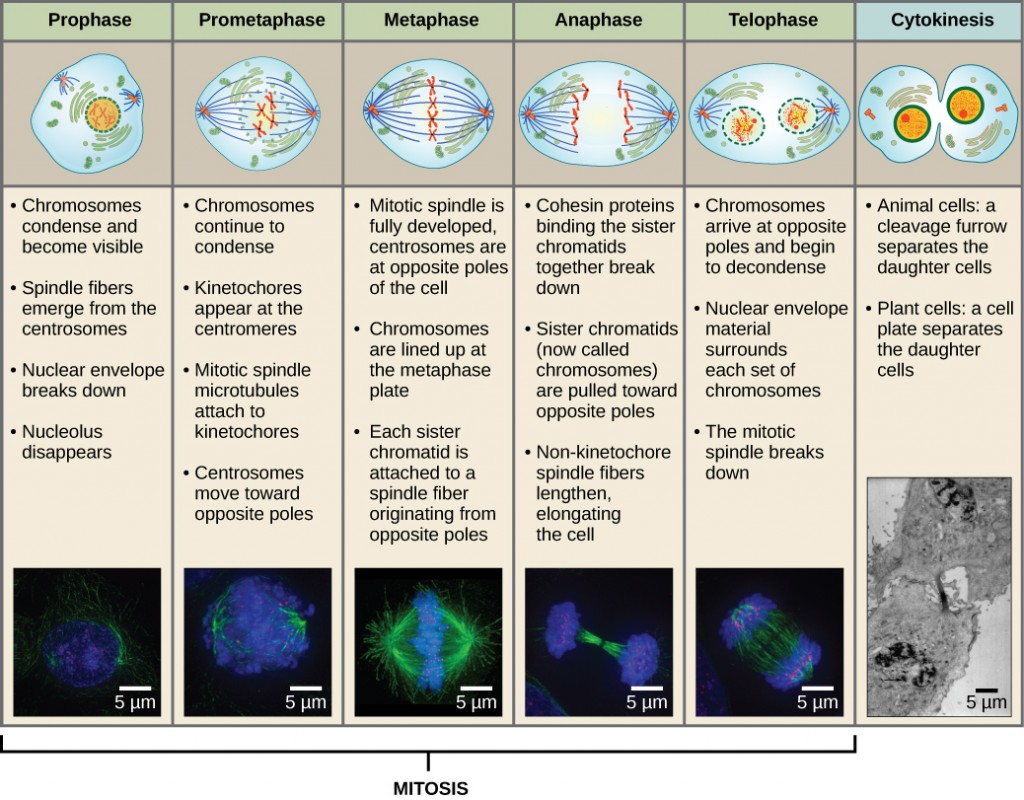
Mitosis is divided into a series of phases—prophase, prometaphase, metaphase, anaphase, and telophase—that result in the division of the cell nucleus (Figure 6.4).
Which of the following is the correct order of events in mitosis?
- Sister chromatids line up at the metaphase plate. The kinetochore becomes attached to the mitotic spindle. The nucleus re-forms and the cell divides. The sister chromatids separate.
- The kinetochore becomes attached to the mitotic spindle. The sis chromatids split. Sister chromatids line up at the metaphase plate. The nucleus re-forms and the cell divides.
- The kinetochore becomes attached to metaphase plate. Sis chromatids line up at the metaphase plate. The kinetochore breaks down and the sister chromatids separate. The nucleus re-forms and the jail cell divides.
- The kinetochore becomes attached to the mitotic spindle. Sister chromatids line up at the metaphase plate. The kinetochore breaks autonomously and the sister chromatids separate. The nucleus re-forms and the prison cell divides.
During prophase, the "offset phase," several events must occur to provide admission to the chromosomes in the nucleus. The nuclear envelope starts to intermission into modest vesicles, and the Golgi appliance and endoplasmic reticulum fragment and disperse to the periphery of the prison cell. The nucleolus disappears. The centrosomes begin to move to reverse poles of the cell. The microtubules that class the footing of the mitotic spindle extend between the centrosomes, pushing them farther apart as the microtubule fibers lengthen. The sister chromatids begin to coil more tightly and become visible nether a light microscope.
During prometaphase, many processes that were begun in prophase continue to advance and culminate in the germination of a connection between the chromosomes and cytoskeleton. The remnants of the nuclear envelope disappear. The mitotic spindle continues to develop as more microtubules assemble and stretch across the length of the sometime nuclear expanse. Chromosomes become more condensed and visually discrete. Each sis chromatid attaches to spindle microtubules at the centromere via a protein circuitous chosen the kinetochore.
During metaphase, all of the chromosomes are aligned in a plane called the metaphase plate, or the equatorial plane, midway betwixt the two poles of the prison cell. The sister chromatids are withal tightly attached to each other. At this time, the chromosomes are maximally condensed.
During anaphase, the sister chromatids at the equatorial plane are separate apart at the centromere. Each chromatid, at present called a chromosome, is pulled rapidly toward the centrosome to which its microtubule was attached. The cell becomes visibly elongated as the not-kinetochore microtubules slide against each other at the metaphase plate where they overlap.
During telophase, all of the events that set up the duplicated chromosomes for mitosis during the first 3 phases are reversed. The chromosomes reach the opposite poles and begin to decondense (unravel). The mitotic spindles are cleaved down into monomers that will exist used to assemble cytoskeleton components for each daughter cell. Nuclear envelopes form effectually chromosomes.
Concept in Activity

This page of movies illustrates different aspects of mitosis. Watch the film entitled "DIC microscopy of cell division in a newt lung prison cell" and identify the phases of mitosis.
Cytokinesis
Cytokinesis is the 2nd part of the mitotic phase during which cell division is completed by the physical separation of the cytoplasmic components into two daughter cells. Although the stages of mitosis are similar for most eukaryotes, the process of cytokinesis is quite unlike for eukaryotes that take cell walls, such every bit plant cells.
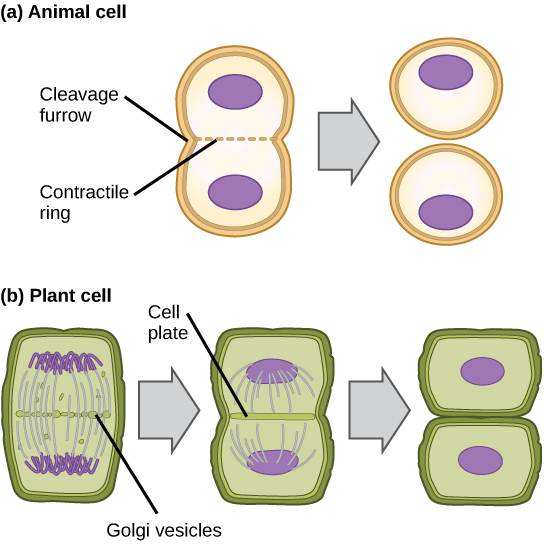
In cells such equally animate being cells that lack cell walls, cytokinesis begins following the onset of anaphase. A contractile ring composed of actin filaments forms just within the plasma membrane at the former metaphase plate. The actin filaments pull the equator of the jail cell inward, forming a crevice. This scissure, or "crack," is called the cleavage furrow. The furrow deepens as the actin ring contracts, and eventually the membrane and jail cell are broken in two (Figure 6.five).
In plant cells, a cleavage furrow is not possible because of the rigid jail cell walls surrounding the plasma membrane. A new cell wall must form betwixt the daughter cells. During interphase, the Golgi appliance accumulates enzymes, structural proteins, and glucose molecules prior to breaking upwardly into vesicles and dispersing throughout the dividing cell. During telophase, these Golgi vesicles motility on microtubules to collect at the metaphase plate. At that place, the vesicles fuse from the eye toward the jail cell walls; this construction is called a cell plate. Every bit more vesicles fuse, the jail cell plate enlarges until it merges with the cell wall at the periphery of the jail cell. Enzymes use the glucose that has accumulated between the membrane layers to build a new jail cell wall of cellulose. The Golgi membranes become the plasma membrane on either side of the new prison cell wall (Figure 6.5).
G0 Stage
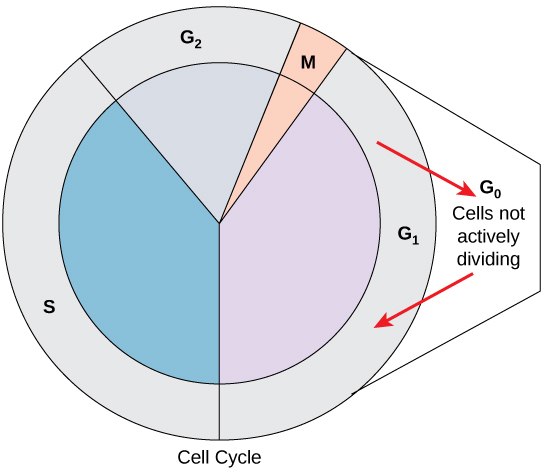
Non all cells adhere to the classic cell-cycle pattern in which a newly formed daughter cell immediately enters interphase, closely followed by the mitotic phase. Cells in the One thousand0 stage are not actively preparing to divide. The cell is in a quiescent (inactive) phase, having exited the prison cell cycle. Some cells enter G0 temporarily until an external betoken triggers the onset of G1. Other cells that never or rarely divide, such every bit mature cardiac muscle and nerve cells, remain in 10000 permanently (Figure vi.vi).
Control of the Cell Cycle
The length of the cell cycle is highly variable even within the cells of an individual organism. In humans, the frequency of cell turnover ranges from a few hours in early embryonic development to an boilerplate of two to five days for epithelial cells, or to an entire man lifetime spent in Yard0 by specialized cells such every bit cortical neurons or cardiac muscle cells. At that place is also variation in the fourth dimension that a cell spends in each stage of the prison cell bicycle. When fast-dividing mammalian cells are grown in culture (outside the body under optimal growing weather), the length of the cycle is approximately 24 hours. In quickly dividing human cells with a 24-hour cell bike, the Gane phase lasts approximately 11 hours. The timing of events in the jail cell cycle is controlled by mechanisms that are both internal and external to the cell.
Regulation at Internal Checkpoints
Information technology is essential that daughter cells exist exact duplicates of the parent cell. Mistakes in the duplication or distribution of the chromosomes lead to mutations that may be passed forrard to every new cell produced from the aberrant cell. To prevent a compromised jail cell from continuing to separate, there are internal control mechanisms that operate at three main cell bicycle checkpoints at which the cell cycle can exist stopped until conditions are favorable. These checkpoints occur almost the stop of K1, at the Thousand2–Grand transition, and during metaphase (Figure 6.7).
The Grandone Checkpoint
The 10001 checkpoint determines whether all conditions are favorable for jail cell partition to go on. The Yard1 checkpoint, also called the restriction point, is the point at which the cell irreversibly commits to the prison cell-division process. In addition to adequate reserves and cell size, there is a cheque for damage to the genomic DNA at the One thousandone checkpoint. A cell that does not meet all the requirements will not exist released into the S phase.
The K2 Checkpoint
The Gii checkpoint confined the entry to the mitotic phase if certain weather are not met. As in the Gi checkpoint, jail cell size and protein reserves are assessed. Withal, the most of import role of the G2 checkpoint is to ensure that all of the chromosomes have been replicated and that the replicated Dna is not damaged.
The Thousand Checkpoint
The M checkpoint occurs near the terminate of the metaphase stage of mitosis. The M checkpoint is too known as the spindle checkpoint considering it determines if all the sis chromatids are correctly attached to the spindle microtubules. Considering the separation of the sister chromatids during anaphase is an irreversible step, the cycle will not keep until the kinetochores of each pair of sister chromatids are firmly anchored to spindle fibers arising from contrary poles of the cell.
Concept in Action

Watch what occurs at the Kane, Thousand2, and 1000 checkpoints by visiting this animation of the jail cell wheel.
Section Summary
The cell wheel is an orderly sequence of events. Cells on the path to jail cell sectionalisation proceed through a series of precisely timed and carefully regulated stages. In eukaryotes, the jail cell wheel consists of a long preparatory catamenia, called interphase. Interphase is divided into 1000i, Southward, and K2 phases. Mitosis consists of five stages: prophase, prometaphase, metaphase, anaphase, and telophase. Mitosis is unremarkably accompanied by cytokinesis, during which the cytoplasmic components of the daughter cells are separated either by an actin ring (animal cells) or by prison cell plate formation (establish cells).
Each step of the cell cycle is monitored by internal controls called checkpoints. There are 3 major checkpoints in the cell cycle: 1 near the terminate of Gane, a second at the Thouii–Thou transition, and the third during metaphase.
Glossary
anaphase : the stage of mitosis during which sister chromatids are separated from each other
jail cell cycle : the ordered sequence of events that a jail cell passes through betwixt one cell division and the adjacent
jail cell bike checkpoints: mechanisms that monitor the preparedness of a eukaryotic cell to advance through the diverse cell bicycle stages
prison cell plate: a structure formed during plant-cell cytokinesis by Golgi vesicles fusing at the metaphase plate; will ultimately pb to formation of a cell wall to separate the two girl cells
centriole: a paired rod-like structure constructed of microtubules at the middle of each animal prison cell centrosome
cleavage furrow: a constriction formed by the actin ring during animal-jail cell cytokinesis that leads to cytoplasmic division
cytokinesis: the sectionalisation of the cytoplasm following mitosis to course two daughter cells
G0 phase: a jail cell-bicycle phase distinct from the G1 phase of interphase; a cell in Grand0 is not preparing to divide
G1 phase : (also, first gap) a jail cell-bike phase; first phase of interphase centered on cell growth during mitosis
Grand2 phase: (besides, second gap) a cell-bike phase; third phase of interphase where the cell undergoes the final preparations for mitosis
interphase: the period of the prison cell cycle leading up to mitosis; includes G1, S, and Yardtwo phases; the interim between ii sequent cell divisions
kinetochore: a protein construction in the centromere of each sis chromatid that attracts and binds spindle microtubules during prometaphase
metaphase plate: the equatorial plane midway between two poles of a cell where the chromosomes marshal during metaphase
metaphase : the stage of mitosis during which chromosomes are lined up at the metaphase plate
mitosis: the menstruation of the cell cycle at which the duplicated chromosomes are separated into identical nuclei; includes prophase, prometaphase, metaphase, anaphase, and telophase
mitotic phase: the period of the cell cycle when duplicated chromosomes are distributed into two nuclei and the cytoplasmic contents are divided; includes mitosis and cytokinesis
mitotic spindle: the microtubule appliance that orchestrates the movement of chromosomes during mitosis
prometaphase : the stage of mitosis during which mitotic spindle fibers attach to kinetochores
prophase: the stage of mitosis during which chromosomes condense and the mitotic spindle begins to course
quiescent: describes a cell that is performing normal prison cell functions and has not initiated preparations for cell division
Due south stage: the 2nd, or synthesis stage, of interphase during which Deoxyribonucleic acid replication occurs
telophase: the stage of mitosis during which chromosomes make it at opposite poles, decondense, and are surrounded by new nuclear envelopes

Source: https://opentextbc.ca/biology/chapter/6-2-the-cell-cycle/
Posted by: hubbardwhatefteld.blogspot.com
0 Response to "What Happens Chromosomes During Metaphase? And Draw It"
Post a Comment