

What Percent Of The Animal Kingdom Do Vertebrates Makeup Lampreys
| ? | ||||||||
|---|---|---|---|---|---|---|---|---|
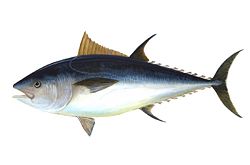 Northern Bluefin Tuna, Thunnus thynnus | ||||||||
| Scientific nomenclature | ||||||||
|
Vertebrates are animals belonging to the subphylum Vertebrata, that is, animals with backbones or spinal columns. Boosted defining characteristics of the subphylum are a muscular system that by and large consists of paired masses, as well every bit a central nervous system that is partly located within the courage. The proper noun of this group comes from the bones of the spinal column (or vertebral column), which are called vertebrae.
Vertebrata is the largest subphylum of the phylum Chordata (chordates), and includes animals with which many people are familiar. Fish (including lampreys), amphibians, reptiles, birds, and mammals (including humans) are vertebrates. Over 50,000 species of vertebrates accept been described. However, more than 95 percent of described animal species are invertebrates—a disparate classification of all animals without backbones.
In general, people feel a strong affinity toward vertebrates. Although invertebrates greatly outnumber vertebrates, it is overwhelmingly vertebrates that are kept as pets or in aquariums and terrariums, as well equally being featured in movies, animated films, and other media. Communities laissez passer laws relating to the humane treatment of vertebrates, and they build zoos for their brandish. The more than like the class of vertebrates is to humans, generally the more the apparent attraction and the more laws for their protection—as seen in the special attention shown to birds and especially mammals, versus fish, amphibians, and reptiles. (For instance, some universities exercise non let enquiry on any vertebrates other than fish, amphibians, and reptiles.) This may be a reflection of the philosophical perspective that people can best love and feel joy from those beings that can virtually mirror their ain grapheme and class.
The study of animals with backbones is called vertebrate zoology. Vertebrate paleontology is the report of animals with backbones through their fossilized remains, and includes studies aimed at connecting animals of the past with modern mean solar day relatives.
Characteristic of vertebrates
In improver to the spinal cord, central nervous organization, and unique muscular system, vertebrates also are characterized by an internal skeleton and a brain case.
The internal skeleton that defines vertebrates consists of cartilage or os, or in some cases both. Information technology is speculated that the first bony substance that vertebrates evolved was an outer skeleton in the form of a bony armor, and that its primary function was as a phosphate reservoir, excreted as calcium phosphate and stored around the body, offering protection at the same time. The internal skeleton provides back up to the organism during the period of growth. For this reason, vertebrates can attain larger sizes than invertebrates, and on average vertebrates are, in fact, larger. The skeleton of most vertebrates, excluding the virtually primitive ones, consists of a skull, the vertebral column, and two pairs of limbs. In some forms of vertebrates, one or both of these pairs of limbs may be absent, such as in snakes or whales. These limbs are assumed to have been lost during the form of evolution.
The skull is idea to have facilitated the development of intelligence as it protects vital organs such as the encephalon, the eyes, and the ears. The protection of these organs is also thought to accept positively influenced the evolution of the high responsiveness to the environment often found in vertebrates.
Both the vertebral column and the limbs offering overall support to the body of the vertebrate. This support facilitates motility, which is normally accomplished with muscles that are attached directly to the bones or cartilages. The muscles form the contour of the body of a vertebrate. A peel covers the inner parts of a vertebrate's body. The pare sometimes acts as a construction for protective features, such as horny scales or fur. Feathers may besides be attached to the skin.
The trunk of a vertebrate houses the internal organs. The middle and the respiratory organs are protected in the trunk. The heart is located either behind the gills, or, in air-animate vertebrates, between the lungs.
The central nervous organisation of a vertebrate consists of the brain and the spinal cord. In lower vertebrates, the brain mostly controls the functioning of the sense organs. In higher vertebrates, the size of the encephalon relative to the size of the body generally is greater. This larger encephalon enables more intensive commutation of information between the different parts of the torso. The nerves from the spinal cord, which lies behind the brain, extend to the skin, the inner organs, and the muscles. Some fretfulness are directly continued to the brain, linking the brain with the ears and lungs.
A 2012 article in the scholarly publication Science identified the world'south smallest known vertebrate as the frog species Paedophryne amauensis, with adults reaching a average size of 7.7 millimeters in length. Its discovery in a rainforest in eastern New Guinea pushed into 2nd place an Indonesian fish from the bother family, with the developed female person fish growing to most seven.ix millimeters (Lee 2012).
The world'southward largest vertebrate is the blue whale (Balaenoptera muscle), which reaches upward to 33 meter (110 ft) in length and 181 metric ton (200 brusk tons) or more than in weight.
Number of species of vertebrates
Vertebrates are the all-time known amid the animals, with most species having been identified and described. There are comprehensive listings of the extant (living) species of mammals, birds, reptiles, amphibians, and fish.
Nevertheless, the conclusion of the number of species of vertebrates is necessarily imprecise. 1 reason is that taxonomists generally strive to suit species based on evolutionary relationships. Equally more insights are obtained, there are taxonomic rearrangements and new nomenclature, fifty-fifty to the point that sometimes species are reclassified as subspecies, and vice-versa. For example, in herpetological classifications, dealing with reptiles and amphibians, the adoption of the evolutionary species concept, versus the previously used biological species concept, led to the elevation of many subspecies to species status (Uetz 2000). Molecular studies are expected to lead to additional rearrangements. A 2nd reason why it is difficult to determine the exact number of species is that new species are continually being discovered and described. Fish are being described at a rate of about 200 per year, amphibians at the rate of about eighty species per year, and reptiles at the charge per unit of well-nigh 60 species per twelvemonth (Eschmeyer, Ferraris, and Hoang 1998; Bauer 1999; Glaw and Kohler 1998; Uetz 2000).
According to a report by Uetz in 2000, comprehensive compilations of vertebrates reveal a species total of four,675 mammals, 9,702 birds, 7,870 reptiles, 4,780 amphibians, and 23,250 fishes. Of the reptiles, the majority were determined to be lizards (4,470 species) and snakes (2,920). Over one half of all reptile species fall into the category of either colubrid snakes (approximately 1,800 species), skinks (i,200 species), or geckos (1,000 species). A subsequent tabulation by Uetz in 2005 showed a total of 8,240 extant reptile species.
A 2004 list of species by the International Union for the Conservation of Nature and Natural Resources (IUCN) yielded the post-obit number of described species of vertebrates: mammals (five,416), birds (9,917), reptiles (8,163), amphibians (five,743), and fishes (28,500). This totals to 57,739 identified vertebrate species. Meanwhile, the IUCN reports a total of one,190,200 described, extant species of invertebrates (although this represents an assumably small proportion of bodily species of this very incompletely known group).
Vertebrates have been traced back to the ostracoderms (primitive jawless fish) of the Silurian Period (444 meg to 409 meg years agone) and the conodonts, a grouping of eel-like vertebrates characterized by multiple pairs of bony toothplates. Vertebrates started to evolve nigh 530 million years agone during the Cambrian explosion.
Taxonomy
Vertebrates (subphylum Vertebrata) are part of the phylum Chordata, which are animals that had, at some stage in their life, a notochord, a hollow dorsal nervus cord, and pharyngeal slits, among other characteristics. Chordata includes 2 subphyla of invertebrates (Urochordata and Cephalochordata) and the Vertebrates.
Vertebrates are also considered role of the Craniata, a group of animals that includes all animals with skulls. Craniata consists of the vertebrates and hagfish (Myxini). In some taxonomies, hagfish, which lack vertebrae, nonetheless are included in Vertebrata based on presumed evolutionary relatedness.
Vertebrates are generally divided into 2 major groups: Agnatha (jawless vertebrates) and Gnathostomata (jawed vertebrates). The tetrapods (amphibians, reptiles, birds, and mammals) are placed in Gnathostomata, likewise every bit those fish with hinged jaws. The lampreys (Petromyzontiformes) are placed in Agnatha, also as several extinct orders of jawless vertebrates. Hagfish are mostly classified in Agnatha, despite the lack of vertebrae. In some classification schemes, Agnatha and Gnathostomata are considered superclasses, and in other schemes Agnatha is considered a class.
Traditionally, seven classes of extant (living) vertebrates are recognized, three of fish and 4 of tetrapods:
- Class Agnatha (jawless vertebrates, lampreys)
- Course Chondrichthyes (cartilaginous fish)
- Class Osteichthyes (bony fish)
- Class Amphibia (amphibians)
- Class Reptilia (reptiles)
- Form Aves (birds)
- Class Mammalia (mammals)
However, the classification of vertebrates past Benton (2004), summarized below, recognizes two different classes of reptiles: († extinct)
- SUBPHYLUM VERTEBRATA
- Grade 'Agnatha'
- Subclass †Conodonta
- Subclass Myxinoidea (hagfish) (not ever placed as vertebrata)
- Subclass Petromyzontidae (lampreys)
- Bracket †Pteraspidomorphi
- Social club †Thelodonti
- Gild †Anaspida
- Bracket unnamed
- Order †Galeaspida
- Society †Pituriaspida
- Order †Osteostraci
- Infraphylum Gnathostomata (jawed vertebrates)
- Class †Placodermi
- Class Chondrichthyes (cartilaginous fish)
- Course †Acanthodii
- Class Osteichthyes (bony fish)
- Subclass Actinopterygii (ray-finned fish)
- Bracket Sarcopterygii (lobe-finned fish)
- Order Actinistia (coelacanths)
- Superclass Tetrapoda (four-limbed vertebrates)
- Class Amphibia (amphibians)
- Serial Amniota (amniotic embryo)
- Class Sauropsida (non-synapsid reptiles)
- Class Aves (birds)
- Class Synapsida (mammal-like reptiles)
- Class Mammalia (mammals)
- Class Sauropsida (non-synapsid reptiles)
- Grade 'Agnatha'
References
ISBN links support NWE through referral fees
- Bauer, A. K. 1999. "Twentieth century amphibian and reptile discoveries." Cryptozoology 13: one-17.
- Benton, Yard. J. 2004. Vertebrate Paleontology, 3rd edition. Blackwell Science Ltd
- Colbert, East. H. 1969. Evolution of the Vertebrates, 2d edition. New York: John Wiley and Sons Inc.
- Eschmeyer, W. N., C. J. Ferraris, and G. D. Hoang. 1998. Catalogue of Fishes, 3 Volumes. San Francisco: California Academy of Science.
- Glaw, F., and J. Kohler. 1998. "Amphibian species variety exceeds tat of mammals." Herpetological Review 29 (1): xi-12.
- Lee, J. J. 2012. ScienceShot: Smaller than a dime, frog is globe's tiniest vertebrate. Science January eleven, 2012. Retrieved August ane, 2012.
- Uetz, P. 2000. "How many reptile species?" Herpetological Review 31(1):13-15.
- Uetz, P. 2005. The EMBL Reptile Database. http://www.embl-heidelberg.de/~uetz/db-info/SpeciesStat.html
Credits
New World Encyclopedia writers and editors rewrote and completed the Wikipedia article in accordance with New World Encyclopedia standards. This article abides by terms of the Artistic Commons CC-by-sa three.0 License (CC-past-sa), which may exist used and disseminated with proper attribution. Credit is due nether the terms of this license that can reference both the New Earth Encyclopedia contributors and the selfless volunteer contributors of the Wikimedia Foundation. To cite this article click here for a list of acceptable citing formats.The history of earlier contributions by wikipedians is accessible to researchers hither:
- Vertebrate history
The history of this article since information technology was imported to New World Encyclopedia:
- History of "Vertebrate"
Annotation: Some restrictions may apply to apply of individual images which are separately licensed.
Source: https://www.newworldencyclopedia.org/entry/vertebrate
Posted by: hubbardwhatefteld.blogspot.com
0 Response to "What Percent Of The Animal Kingdom Do Vertebrates Makeup Lampreys"
Post a Comment